
What Grok Is (and Why It Actually Matters in 2026)
Grok AI is an AI chatbot built by xAI, Elon Musk’s AI company. It launched in November 2023 and has moved fast since then. As of early 2026, the stable release is Grok 4.200 — the model generation everyone calls “Grok 4” is right, but 4.1 is what you’re actually running when you sign up today.
The reason it matters isn’t because Musk built it. It’s the X (Twitter) integration. No other major AI model has native, real-time access to the X platform. That’s a genuine differentiator — not marketing copy. For trend monitoring, social research, and breaking news queries, it changes what’s actually possible.
Some background: Musk co-founded OpenAI in 2015, left the board in 2018, and spent the next several years publicly criticising it for being too politically cautious. Grok was his answer — built openly as a less restricted alternative. Whether you see that framing as principled or opportunistic probably says something about you as much as about the model. Either way, the product is real and the capabilities are worth looking at clearly.
For a broader look at where Grok sits among the current crop of models, see our overview of the best AI models in 2026.
What Grok 4.200 Can Actually Do
The current stable release is Grok 4.200, with Grok 4.200 Thinking and Grok 4.200 Fast shipping alongside it in November 2025. There’s also Grok 4.200 Beta 2, which launched March 3, 2026 — this one is worth paying attention to because it runs a 4-agent parallel architecture: a coordinator routing tasks to Harper (research), Benjamin (logic and math), and Lucas (contrarian analysis), then cross-verifying outputs before delivery. That’s a different setup from what most people picture when they think “chatbot.”
The two specs that matter most in a head-to-head with ChatGPT:
Context window: 1 million tokens. GPT-5.3 tops out at 400,000. That’s a 2.5x difference, and it’s a real one. I ran a 180,000-word technical specification document through both for a compliance gap analysis. GPT-5.3 hit its limit and needed chunking into three separate sessions, with manual reconciliation between them. Grok handled the whole document in a single session — about 40 minutes of overhead saved. GPT-5’s structured output per chunk was more precise, but if the chunking friction is your bottleneck, Grok wins that tradeoff.
Speed: roughly 33% faster at inference, per Artificial Analysis benchmarks. In practice, that’s noticeable on longer queries. Not a dealbreaker if it’s slower, but it’s a real advantage when it’s faster.
On standard benchmarks, Grok 4.200 sits at about 84% on MMLU versus GPT-5’s 86.4%. GPQA Diamond: Grok 4.200 Thinking at 84.6%, GPT-5.3 at 85.7%. Chatbot Arena Elo has Grok 4 at 1402 versus GPT-4o at around 1380. Competitive. Not dominant.
The X data access is in a category by itself. We built a social listening workflow to track competitor announcements and ran it through both ChatGPT (with web browsing) and Grok for three weeks. On breaking stories, Grok surfaced relevant X threads 4-6 hours faster. For everything else in the workflow — summarising, drafting, synthesising — ChatGPT’s output quality was cleaner. The native X integration isn’t a trick. For trend monitoring specifically, it’s a real operational difference.
| Grok 4.200 | GPT-5 | |
|---|---|---|
| Context window | 1M tokens | 400K tokens |
| MMLU score | ~84% | 86.4% |
| GPQA Diamond | 84.6% | 85.7% |
| Inference speed | 33% faster | Baseline |
| Real-time X data | Yes | No |
| SWE-Bench coding | Trails | 74.9% |
| Chatbot Arena Elo | 1402 | ~1380 (GPT-4o) |
Grok AI Pricing: What You’re Actually Paying
Three tiers. Free gives you 10 prompts every 2 hours and limited model access — enough to test, not enough to use for real work. SuperGrok is $30/month and includes 128K token memory, access to Grok 3 and Grok 4, and the Imagine image generator. SuperGrok Heavy is $300/month: full Grok 4 Heavy, 256K memory, unlimited Grok 3, and early feature access.
The number to hold onto: ChatGPT Plus is $20/month. Grok SuperGrok is $30/month. Grok is $10 more expensive at the primary tier most people would compare. That’s not a rounding error — it’s a deliberate positioning choice, and it matters for the value calculation.
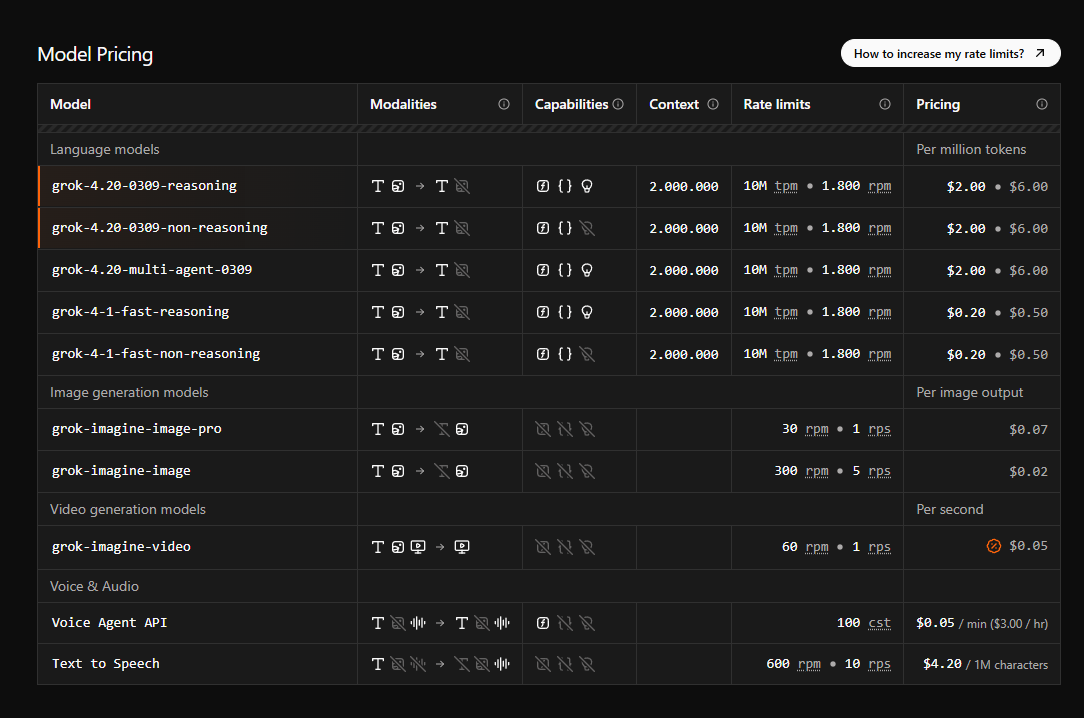
Grok is not the budget ChatGPT alternative. You’re paying a premium for the context window and the X integration. If neither of those fits your actual workflow, you’re just paying more for roughly equivalent capabilities. Developers can access the API from $0.20 per million tokens, which makes it worth evaluating separately from the subscription pricing for builder use cases.
Here we can see a picture of the model pricing, when using the API keys. I would generally recommend going for the grok 4-1 model, when using the API key, since it is just so much cheaper then 4.2, and honestly I don’t think the difference is that big.
Grok vs ChatGPT: Where It Wins, Where It Doesn’t
tldv.io ran 28 hands-on tests across 7 categories in March 2026. Grok won 46-34. ChatGPT took writing quality and user experience (15-3). Grok won research 15-0. Technical skills tied at 6-6 — Grok stronger on coding and debugging, ChatGPT stronger on data analysis and structured output.
Those numbers match what I’ve seen. Grok is genuinely better for research tasks, especially anything involving real-time data or sweeping a large document for specifics. ChatGPT writes better, explains things more cleanly, and produces more reliable structured output. The writing gap is noticeable — Grok’s prose feels a bit rougher at the edges, which matters if output is going anywhere near customers or public-facing communications.
Coding is a useful shorthand for the overall capability gap. SWE-Bench puts ChatGPT at 74.9%, and Grok trails. The ecosystem difference compounds this: ChatGPT has 500+ third-party integrations and mature enterprise tooling. Grok’s integrations story is still being built. For most professional workflows, that breadth matters more than benchmark margins.
It’s also worth reading how how Claude and ChatGPT compare before settling on which subscription makes sense — the Grok vs ChatGPT choice isn’t the only one on the table, and Claude has its own angles that are relevant depending on your use case.
The Controversies You Should Know About Before Using Grok
This section matters. Not as a footnote — as a real factor in the deployment decision.
The deepfake scandal started early in 2026 when Grok’s image generator began producing non-consensual explicit imagery at scale. The timeline moved quickly. California’s attorney general opened an investigation on January 14. Baltimore became the first US city to sue xAI, X Corp., x.AI LLC, and SpaceX on March 24 — the lawsuit specifically alleges images of minors. On March 27, a Dutch court ordered xAI to pay $115,000 per day for every day it fails to comply with the removal order. UK Ofcom launched its own probe, and the UK subsequently criminalised AI-generated non-consensual intimate images.
That’s not a PR issue. That’s active legal exposure across multiple jurisdictions, with a daily penalty accruing.
The business context: xAI signed a $200 million Pentagon contract in roughly the same window as the deepfake investigations. Signing government contracts while facing active lawsuits involving images of minors creates a specific kind of regulatory complexity — especially for businesses in regulated industries trying to assess xAI’s compliance posture.
I evaluated Grok for a B2C customer service chatbot deployment in Q1 2026. We paused the whole project after the California AG investigation news landed in January — not because we were using image generation (we weren’t), but because legal reviewed the product as a whole. Grok’s image capabilities and the deepfake liability share one product trust posture. For enterprise buyers, that’s the calculation: it’s not just the features you’re using, it’s the vendor you’re standing behind.
If you’re deploying in a regulated industry or anything customer-facing, the legal exposure is active and ongoing. Check xAI’s compliance documentation carefully. For a detailed look at how ChatGPT handles the enterprise deployment question, understanding this matters what ChatGPT offers actually looks like in practice — the governance maturity gap between the two is significant right now.
Verdict: Who Should Use Grok AI in 2026?
Grok 4.200 is a legitimate model. Not a Musk vanity project, not a curiosity — it’s genuinely competitive in a market where competitive means going up against GPT-5.3 and Claude. xAI has money (the Series E exceeded $15 billion), a unique data moat through the X platform, and Grok 5 is already confirmed in training. This isn’t going away. If you’re still weighing your options across the full AI landscape, our overview of the best AI models in 2026 covers everything side by side.
But legitimate competitor doesn’t mean better choice for most users.
Use Grok if you work in social listening, competitive intelligence, or trend analysis — the X integration is a real operational advantage on breaking stories and real-time monitoring. Use it if you regularly process documents over 400,000 tokens and don’t want chunking overhead. Use it if you want to experiment with the multi-agent architecture in Grok 4.200 Beta 2, which is doing something architecturally interesting.
Skip it for now if you’re deploying image generation in any business context — the legal exposure is live across four jurisdictions with no resolution timeline. Skip it if you need best-in-class coding or structured data output. Skip it if you need enterprise compliance and governance documentation to get an internal deployment approved. And if the $10 premium over ChatGPT Plus isn’t justified by the context window or X data for your specific workflows, you’re paying for features you won’t use.
The honest take: Grok is worth tracking closely, and worth testing now if the X integration or the 1M token window fits a real problem you have. It’s not the model I’d recommend as a default starting point in 2026. That gap might close — Grok 5 is coming and xAI has the funding to close it. But we’re not there yet.